Lecture slides on Immigrant Optimism
Readings for this session: Salikutluk (2016); Teney, Devleeshouwer, and Hanquinet (2013).
Summary: This is my third and final of three guest lectures for the course “Gender, Ethnicity, and Post-Colonialism”. In this lecturre we ask: How do the children of immigrants fare in the education system? Over the past decades research on the educational attainment of the so-called ‘second generation’ (i.e., the children of immigrants) in Western countries has come to two firm and generally accepted conclusions. In this lecture I will introduce the students to both of these important insights.
The children of immigrants tend to show lower academic performances than the children of native-born parents. This largely stems from disadvantages because of their (on average) lower language skills, lack of information about the education system, and lower parental resources (Heath and Brinbaum, 2007; Alba, Sloan, and Sperling, 2011). We will discuss how, in this regard, the second generation resembles native kids from disadvantaged working-class backgrounds.
But in contrast to other disadvantaged groups such as working-class kids, the children of immigrants hold particularly ambitious educational and vocational aspirations, a pattern that is often summarized under the term ‘immigrant optimism’ (Kao and Tienda, 1995). The lecture will explain how regression techniques allow us to identify these aspirations and how they lead the second generation to strive for more ambitious educational goals than similarly-performing kids of native-born parents. Moreover, after discussing several rivaling explanations, we will conclude that these high aspirations likely stem from the positive selection mechanism deeply rooted in the process of international immigration (Kao and Tienda, 1995; Engzell, 2019).
The figure below testifies immigrant optimism for the case of Denmark. It shows that the children of immigrants are more likely than native Danish kids to choose the academic (over the vocational) high school track (Y-axis), at most levels of performance displayed on the X-axis.
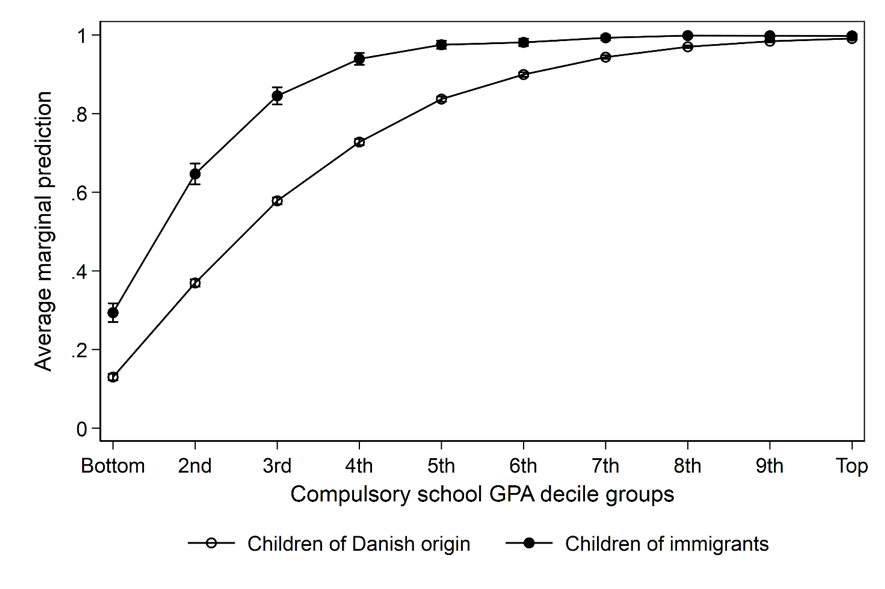
Source: Birkelund (2019)
References
Alba, R., J. Sloan, and J. Sperling (2011). “The Integration Imperative: The Children of Low-Status Immigrants in the Schools of Wealthy Societies”. In: Annual Review of Sociology 37.1, pp. 395-415. DOI: 10.1146/annurev-soc-081309-150219.
Birkelund, J. F. (2019). “Aiming High and Missing the Mark? Educational Choice, Dropout Risk, and Achievement in Upper Secondary Education among Children of Immigrants in Denmark”. In: European Sociological Review. DOI: 10.1093/esr/jcz064.
Engzell, P. (2019). “Aspiration Squeeze: The Struggle of Children to Positively Selected Immigrants”. In: Sociology of Education 92.1, pp. 83-103. DOI: 10.1177/0038040718822573.
Heath, A. F. and Y. Brinbaum (2007). “Guest Editorial: Explaining Ethnic Inequalities in Educational Attainment”. In: Ethnicities 7.3, pp. 291-304. DOI: 10.1177/1468796807080230.
Kao, G. and M. Tienda (1995). “Optimism and Achievement: The Educational Performance of Immigrant Youth”. In: Social Science Quarterly 76.1, pp. 1-19.
Salikutluk, Z. (2016). “Why Do Immigrant Students Aim High? Explaining the Aspiration–Achievement Paradox of Immigrants in Germany”. In: European Sociological Review 32.5, pp. 581-592. DOI: 10.1093/esr/jcw004.
Teney, C., P. Devleeshouwer, and L. Hanquinet (2013). “Educational aspirations among ethnic minority youth in Brussels: Does the perception of ethnic discrimination in the labour market matter? A mixed-method approach”. In: Ethnicities 13.5, pp. 584-606. DOI: 10.1177/1468796812472009.